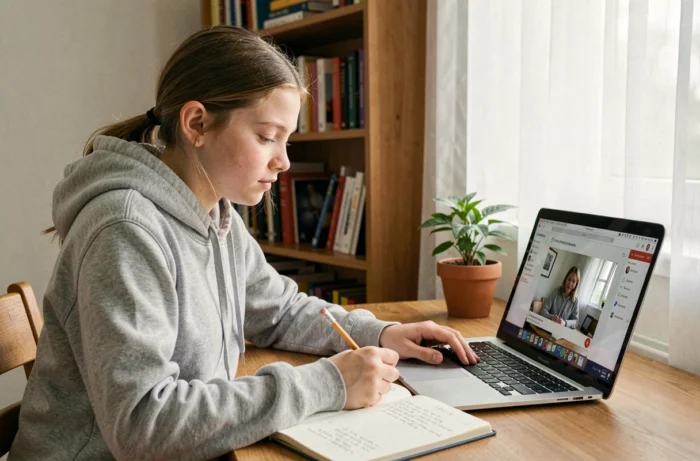
Online tutoring is not just about transposing a private lesson onto a screen. When a student accumulates learning difficulties, the distance modality profoundly alters the pedagogical relationship, the pace of work, and the available remediation levers. Understanding these mechanisms allows for the selection of truly tailored support rather than a mere digital substitute for home tutoring.
Cognitive load and online tutoring: structuring attention rather than adding screen time
A struggling student often suffers from cognitive overload when faced with school tasks. The online format, if poorly designed, exacerbates this issue by multiplying visual stimuli and distractions. The PISA 2025 results confirm that a moderate use of digital tools for learning is more beneficial than intensive use, and that distraction from devices is associated with lower results and decreased engagement.
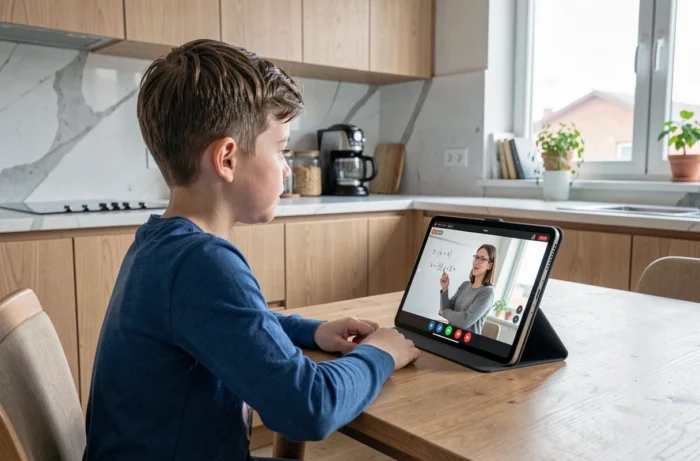
We therefore recommend checking how a platform concretely manages the student’s attention. An individual video conference lesson, with screen sharing controlled by the teacher, limits distraction. Conversely, unrestricted access to a library of exercises without a tutor can turn the session into passive browsing.
Families looking to benefit from Soutien Adom online should ask a simple question beforehand: does the teacher guide the session, or does the student navigate alone in an open environment?
A good indicator of pedagogical quality is the presence of a session start protocol (reminder of objectives, verification of previous knowledge, announcement of the plan). This framing reduces cognitive load from the very first minutes and places the student in an active posture.
Learning difficulties and personalized support: what distance learning really changes
Personalization is the most frequently repeated argument by online course platforms. In practice, the quality of this personalization depends on two technical factors that mainstream articles rarely mention.
The initial diagnosis conditions everything else
An effective online tutor begins with a structured skills assessment, not a simple informal exchange. This assessment identifies specific gaps (for example, lack of mastery in factoring in grade nine, rather than a vague “problem in math”) and defines measurable short-term objectives.
Without this diagnosis, online lessons replicate the main flaw of traditional support: the teacher addresses visible symptoms rather than underlying causes. The student completes their homework with help, but the underlying gaps persist.
The digital written record as a tracking tool
Distance learning offers a structural advantage that is often underutilized: each session can generate a shared report (completed exercises, recurring errors, points to revisit). This objective tracking allows parents to measure progress without relying solely on the child’s feelings.
We observe that families who regularly consult these reports detect stagnations earlier and can adjust the frequency or content of sessions.
Artificial intelligence and online homework: the limits that struggling students must know
Generative AI has changed students’ relationship with homework. A middle or high school student in difficulty is naturally tempted to submit their exercises to an AI tool for an immediate answer. PISA 2025 data shows an association between intensive AI use for homework and lower results, although the OECD specifies that no causal link can be established.
The role of quality online tutoring here is twofold:
- Teach the student to verify and question the answers generated by AI rather than simply copying them, developing a critical validation reflex
- Use AI as a supervised educational support (generating additional exercises, reformulating a statement) under the teacher’s supervision
- Identify exercises where the student has clearly delegated the resolution to a tool, in order to turn it into a learning lever rather than a reason for sanction
This educational function regarding AI is still underdeveloped in traditional schooling. An online support platform can fill this gap by systematically integrating moments of confrontation between the tool’s response and the student’s reasoning.
Online private lessons: concrete criteria for choosing a teacher suited to the student’s difficulties
The pool of teachers available online is significantly larger than in-person, especially outside major urban areas. This abundance does not exempt one from applying precise selection criteria.
- Specialization in the relevant school level (middle school or high school) takes precedence over a general diploma. A mathematics professor is not necessarily the best choice for a sixth-grade student struggling with fractions
- Documented experience with profiles of students with learning difficulties, and not just with students preparing for selective exams
- The ability to provide written feedback after each session, proof of structured and not improvised follow-up
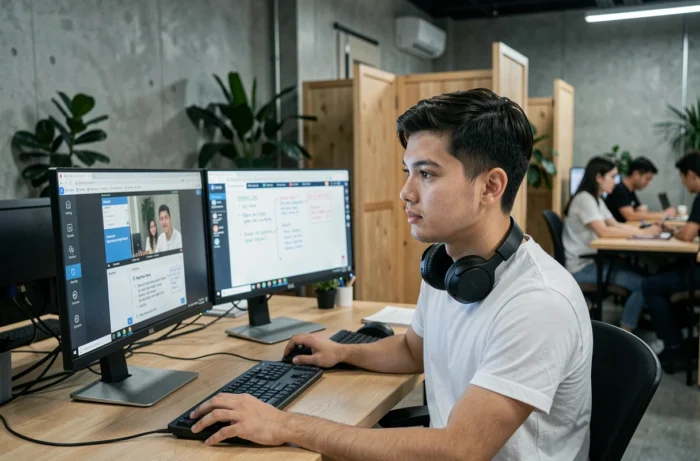
- Mastery of educational video conferencing tools (interactive whiteboard, real-time annotation), which conditions the fluidity of the lesson
A teacher who does not master these tools turns the session into an illustrated phone conversation, which significantly reduces effectiveness for a student who needs visual support.
The choice of time slot also deserves consideration. A struggling student benefits more from a session scheduled away from class hours, when their cognitive fatigue is lower. Saturday mornings or Wednesday afternoons remain more productive times than a late slot during the week after a day at school.
Online tutoring is neither a miracle solution nor a mere logistical convenience. Its value rests on the rigor of the initial diagnosis, the quality of follow-up between sessions, and the teacher’s ability to structure a student’s attention, which the screen can both capture and disperse. Families who ask these questions before committing achieve significantly more lasting results.