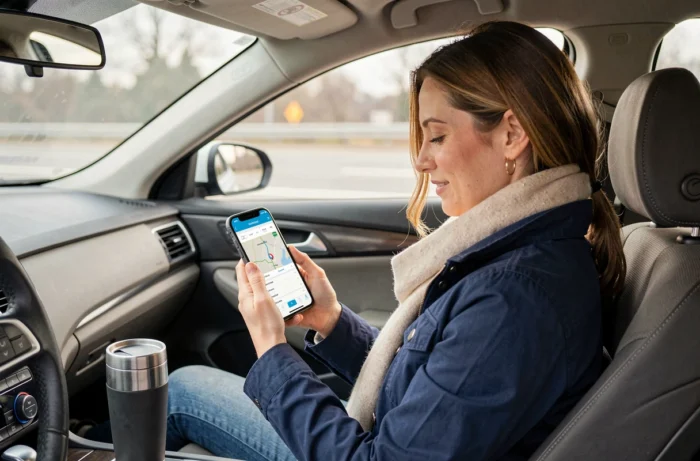
The cost of a carpool trip is based on a sharing of actual expenses between the driver and passengers. Calculating this cost requires identifying the expense items related to the vehicle and then distributing them according to the number of occupants. This sharing logic has a direct legal constraint: the driver must not make a profit from the amounts received, under penalty of shifting to a paid activity with tax consequences.
Expense items to include in the cost of a trip
Before setting a price or comparing offers, it is essential to understand what the actual cost of a car trip covers. Three categories of expenses are included in the calculation.
Fuel is the most visible expense item. Consumption depends on the type of vehicle, driving style, and type of road (highway, national, urban). To estimate this expense, simply multiply the average consumption per 100 km by the price per liter, then by the distance of the trip.
Toll fees constitute the second expense item, often underestimated on long trips. On a Paris-Lyon highway trip, the toll can weigh as much as the fuel. Some alternative routes allow avoiding them, at the cost of a longer travel time.
The third item concerns vehicle wear and tear: tires, brakes, oil changes, shock absorbers. These maintenance costs increase with mileage. Carpooling platforms rarely include them in their calculators, but they exist and impact the driver’s annual budget. A detailed guide on calculating carpooling prices on Autour 2 Moi allows for refining this estimate by taking all these variables into account.
Distribution of the price between driver and passengers
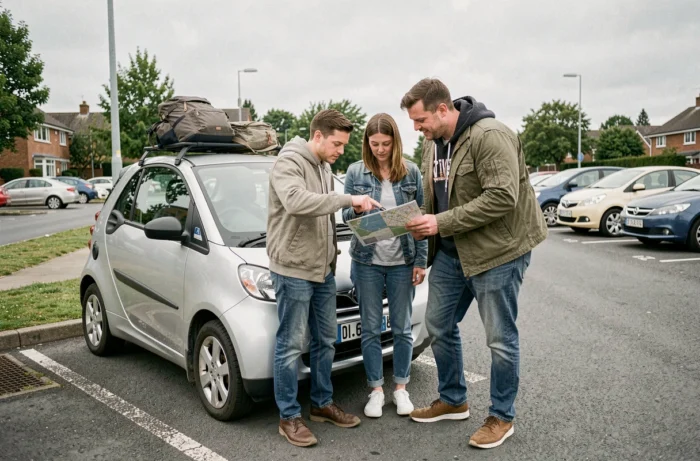
The principle of carpooling is based on a division of costs. The driver pays their share just like the other occupants. With two passengers, the total cost of the trip is divided by three (including the driver).
This distribution has a clear legal limit. The amounts received by the driver must only cover their share of the trip expenses. Exceeding the cost-sharing turns carpooling into a commercial activity, which implies different reporting and tax obligations.
Platforms generally apply this logic in their suggested price algorithms. The proposed amount takes into account the distance, average fuel cost, and number of available seats. Adjusting this price upwards beyond reasonable limits reduces the chances of finding passengers and poses a regulatory risk.
The case of commuting trips
For daily trips, regularity changes the game. Carpooling five days a week with one or two colleagues allows for a significant division of the monthly fuel budget. It is on these recurring trips that savings are most tangible, as the fixed costs of the vehicle (insurance, parking) remain the same whether one carpools or not.
Employer and local community aids for carpooled trips
The actual cost of a carpool trip is not limited to the sharing among occupants. Several schemes can reduce the bill, but their existence depends on the employer or local community.
- The sustainable mobility allowance allows a private sector employer to cover carpooling commuting trips. This allowance applies to both the driver and the passenger but remains optional: its amount and conditions vary from one company to another.
- Some local communities offer direct incentives. Île-de-France Mobilités, for example, has set up a scheme where the passenger benefits from a reduced fare and the driver receives compensation per passenger based on the distance traveled.
- The national “Coup de pouce covoiturage” scheme, funded by energy savings certificates, was abolished on January 1, 2025. The aids currently available are therefore mainly local or employer-related.
Checking these schemes before calculating one’s trip budget can significantly change the final cost. A locally subsidized trip can sometimes cost less than public transport on the same route.

Reducing the cost per kilometer: concrete levers
Beyond sharing and aids, several practical choices directly influence the cost per kilometer of a carpool.
Adapting the route
Avoiding toll highways on medium distances reduces the bill without necessarily extending the trip prohibitively. On certain routes, the time difference between highway and national road is just a few minutes, while the toll can represent a significant part of the total cost.
Optimizing vehicle occupancy
Going from one to two passengers mechanically divides the cost per person. Publishing one’s trip on multiple carpooling platforms or apps increases visibility and the chances of filling available seats. For commuting trips, setting a convenient meeting point (park and ride, bus stop) facilitates coordination.
Reducing fuel consumption
Smooth driving (anticipating braking, stabilized speed, cruise control on the highway) measurably decreases consumption. Checking tire pressure before a long trip also contributes to this. These actions may not seem spectacular when taken individually, but when accumulated over a year of daily trips, they significantly lighten the fuel budget.
Comparing with public transport
On certain suburban routes, carpooling is faster and cheaper than the bus or train, especially when connections extend travel time. On other well-served routes, public transport remains more competitive. Comparing the actual cost after aids (employer allowance, transport subscription, local incentives) allows for choosing the most suitable solution for each trip.
The cost of a carpool is managed at three levels: the accuracy of the initial calculation, the number of passengers on board, and the aids one is entitled to without always knowing it. Checking with one’s employer about the existence of a sustainable mobility allowance remains the first reflex to have, even before posting an ad.