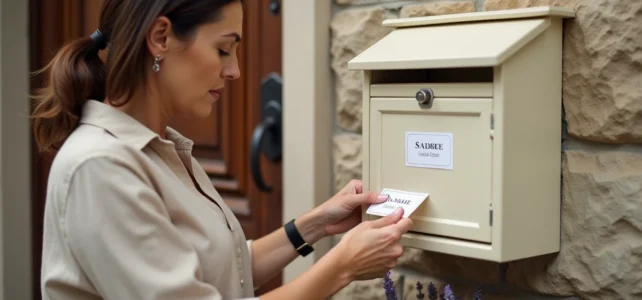
Displaying multiple names on a single mailbox is a common situation in France, whether for a couple, a shared apartment, or temporary accommodation. No legal text formally prohibits this practice, but postal constraints and technical standards regulate what is actually feasible on a plaque of a few square centimeters.
NF standard for nameplates: the physical constraint that no one measures
The issue of multiple names on a mailbox is less about legal grounds and more about the available space. The NF D 27-404 (indoor mailboxes) and NF D 27-405 (outdoor mailboxes) standards require a nameplate of at least 100 mm x 24 mm for any building whose building permit is dated after July 12, 1979.
This format is sufficient for a surname, possibly accompanied by a first name. Adding a second full name makes the plaque difficult to read, especially if the names are long. The standards do not set a maximum number of names, but they require readability from outside the mailbox. An overloaded plaque can therefore be considered non-compliant, even if no text explicitly prohibits it.
In practice, the possibility of putting multiple names on a mailbox depends as much on the chosen plaque format as on the number of characters to be engraved. A married couple with a hyphenated surname (birth name combined with marital name) already occupies most of the standardized space.
Usage name, shared accommodation, hosting: distinct cases in law
Not all situations are equal. The administration recognizes the right to display a usage name on one’s mailbox. A married person can therefore display their birth name and marital name without legal difficulty. This is not “two people on one mailbox,” it is one person with two recognized administrative identities.
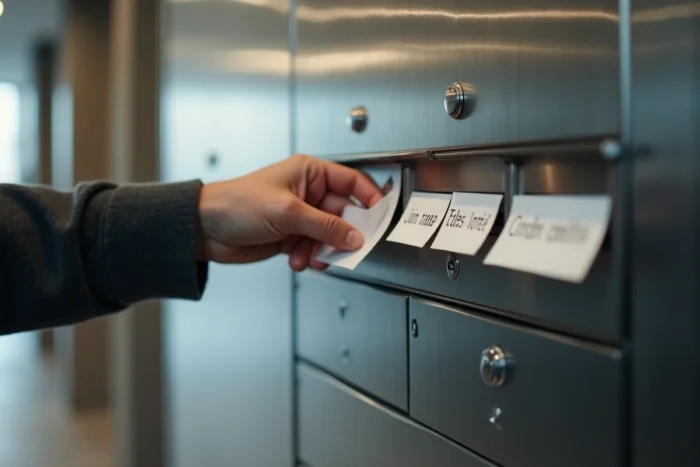
Shared accommodation follows a different logic. Each roommate has their own right to receive mail. The mail carrier distributes based on the names displayed. If three roommates live in the same residence but only one name appears on the plaque, the other two are considered unknown at the address by La Poste.
The hosted person, a often misunderstood case
A person hosted free of charge usually does not appear on the lease. Their name may appear on the mailbox for practical reasons of mail delivery. The landlord cannot absolutely oppose this, but the condominium regulations may govern the format and appearance of nameplates.
The displayed name does not serve as proof of residence. It facilitates mail reception, nothing more. To establish proof of residence, a hosting certificate or a separate administrative document is required.
Mail distribution and La Poste’s database: the real filter
Beyond physical standards and legal frameworks, it is the postal distribution system that ultimately decides. La Poste relies on its internal databases to verify the correspondence between the recipient’s name and the delivery address. When a name does not appear on the mailbox or in these databases, the mail is returned to the sender marked “unknown recipient.”
This mechanism has concrete consequences for people who move in or add a name to their mailbox:
- Reporting the new name to La Poste (via a forwarding contract or a change of address declaration) speeds up the recognition by the local mail carriers
- In the absence of reporting, the recognition period can take several weeks, during which mail may be returned
- Registered letters are particularly sensitive to this point, as the mail carrier verifies the recipient’s identity at the time of delivery
Therefore, simply adding a name to the plaque is not enough. That name must also be recognized in the postal system for distribution to function properly.
Condominium and nameplates: who decides on the format
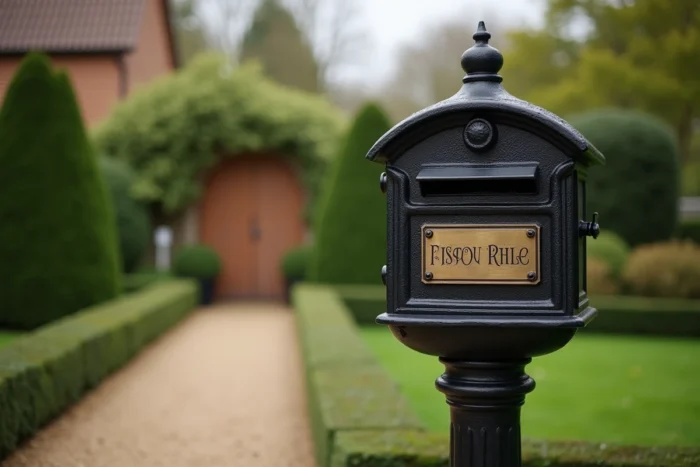
In a collective building, the issue becomes more complicated with the condominium regulations. Some condominiums impose a uniform model for the plaque, with standardized size, font, and background. Adding a second or third name may require changing the plaque format, which sometimes necessitates the agreement of the property manager.
The cost of changing the nameplate falls to the occupant, whether they are a tenant or an owner. The property manager only covers the common elements of the mailbox block, not the individual plaques.
The most common situations:
- A couple wishing to display both surnames must check that the plaque format allowed by the condominium physically permits it
- A roommate added during the lease can engrave a new plaque at their own expense, adhering to the imposed model
- A landlord changing tenants must ensure that the previous name is removed before the new one is installed, to avoid distribution confusion
In a single-family home, these constraints disappear. The owner freely chooses their mailbox and plaque, respecting the standardized dimensions if the residence was built after 1979.
Displaying multiple names on a mailbox remains possible in the vast majority of cases. The real limit is not legal but practical: available space on the plaque, readability required by standards, and recognition of the name in the postal system. Before adding a name, checking these three points avoids most issues with undelivered mail.