
The choice of an exercise bike hinges on three technical parameters that most guides gloss over: the mass of the flywheel, the type of resistance, and the software compatibility with training platforms. We will detail these points to guide a purchase that lasts over time.
Flywheel and pedaling quality: the criterion that product sheets hide
The flywheel determines the smoothness of pedaling. A low mass produces a jerky movement, with a very noticeable dead point at the top and bottom. The heavier the wheel, the more consistent the acceleration effect, making it closer to a road bike.
We recommend aiming for a flywheel of at least six to eight kilograms for regular cardio-oriented use. Below this, the maximum resistance will be reached quickly, a recurring problem reported by users who progress quickly and find themselves stuck at the highest level after a few weeks.
Mass alone is not enough. The ratio between the weight of the wheel and the transmission ratio (size of the chainring and sprocket) directly influences the usable resistance range. Two devices with the same flywheel mass can offer radically different pedaling sensations depending on their transmission. The comparisons available on velo-appartement.org allow for cross-referencing these technical data between models.
Magnetic or electromagnetic resistance: impact on progression
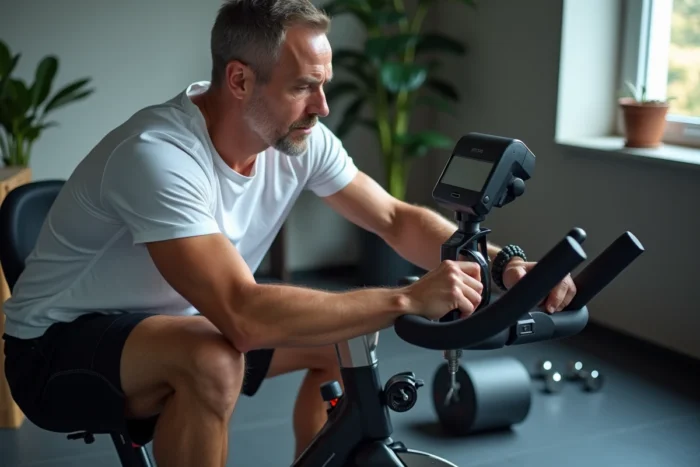
An exercise bike with manual magnetic resistance uses a permanent magnet whose distance from the wheel is adjusted via a knob. The number of resistance levels varies by model, but the transition from one level to another often lacks finesse. This system is suitable for moderate use, without a precise goal of tracking the load.
Electromagnetic resistance (or motorized) controls the load via an electrical signal sent to the electromagnet. The direct advantage: the resistance adjusts to the watt level from the console or an app. This type of braking allows for automated training programs where the difficulty adapts in real-time to the course profile or heart rate.
For structured training with intervals or calibrated power sessions, electromagnetic resistance is not a luxury. It is the only technology that guarantees the reproducibility of effort from one session to another.
Connectivity and compatibility with virtual cycling platforms
One of the major changes in the market concerns the rise of exercise bikes compatible with virtual cycling apps like Zwift, Rouvy, or MyWhoosh. This compatibility relies on two wireless communication protocols: ANT+ and Bluetooth Smart.
- ANT+ simultaneously transmits cadence, power, and heart rate to multiple receivers, making it suitable for multi-screen setups or external sensors
- Bluetooth Smart consumes less energy and connects directly to tablets and smartphones without an additional dongle
- The most versatile models integrate both protocols, avoiding being locked into a single application ecosystem
A bike sold as “connected” but limited to its proprietary app loses much of its appeal. We observe that FE-C (Fitness Equipment Control) compatibility is the true indicator of a device usable on third-party platforms. This protocol allows the app to control the bike’s resistance in real-time, replicating the climbs and descents of a virtual course.
Without FE-C, the bike transmits data but does not receive instructions. The training experience remains passive.
Semi-recumbent exercise bike: an underestimated therapeutic use
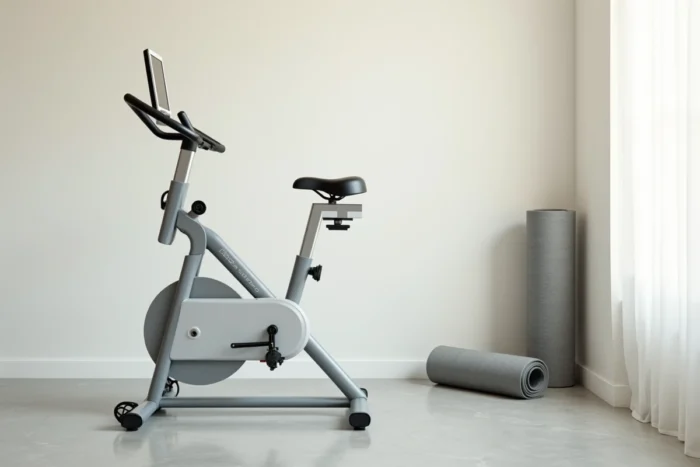
Semi-recumbent models position the cyclist with their back supported by a backrest and legs extended forward. This geometry reduces the load on the lower back and wrists, two areas of frequent tension on a classic upright bike.
The use in post-operative rehabilitation or joint recovery is the natural territory for these devices. Specialized brands now offer models with very low resistance levels, suitable for recovering individuals looking for cardiovascular work without mechanical stress on weight-bearing joints.
The compromise lies in the space taken up. A semi-recumbent bike occupies significantly more floor space than an upright or foldable bike. For a modest-sized apartment, the question of space must be resolved before that of comfort.
Console and training programs: what makes the difference in use
The built-in console of an exercise bike ranges from a simple LCD screen displaying time, distance, and calories, to integrated tablets with preloaded programs and heart rate tracking.
- Basic consoles are sufficient if training is controlled by an external app on a tablet or smartphone
- Intermediate consoles offer automated training programs (intervals, progressive increase, maintenance of target heart rate) controlling the electromagnetic resistance
- High-end consoles include a touchscreen, video courses, and direct Wi-Fi connectivity
The common trap: investing in a high-end console when the actual use will be via Zwift on an iPad placed on the handlebars. It is better to focus the budget on mechanics and connectivity rather than on an integrated screen that will be bypassed.
A well-chosen exercise bike relies on the match between pedaling quality, resistance technology, and compatibility with the training tools you are already using. The rest, from the bottle holder to the calorie counter, falls under accessory comfort.