
An L-shaped sofa stuck in a staircase, an upright piano that won’t fit through the landing door: these situations turn an ordinary move into a puzzle. The moving lift, this external elevator fixed to the facade, allows you to bypass the problem in just a few minutes. However, you need to know in which situations this rental is truly justified and what it entails in terms of preparation.
Facade constraints and permits: what no one checks early enough
Before even comparing quotes, the first question to ask is about access to the facade. The lift needs a parking space at the foot of the building to position the truck-mounted platform. Narrow street, sidewalk lined with trees, awning above the entrance: each of these elements can prevent installation.
In most municipalities, occupying public space with a lift requires a parking permit issued by the town hall. The time it takes to obtain this varies by city, but it generally requires several days, sometimes several weeks in advance. Without this document, the operator may refuse to intervene on the day.
Also consider the height. A standard lift reaches the usual floors of a residential building. For taller buildings or atypical configurations (protruding balconies, shutters that do not open completely), specific equipment is needed, often at a higher cost. Knowing when to rent a lift for moving therefore requires first inspecting the facade and measuring the window openings.
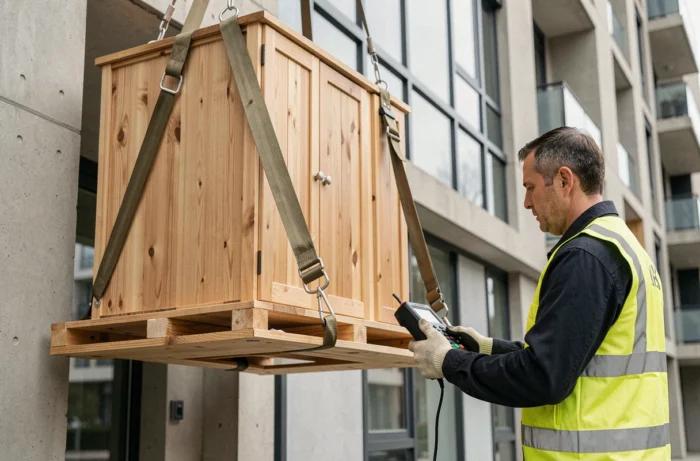
Lift rental: duration, type of equipment, and what affects the price
Lift rental is most often charged by the half-day or full day. The price depends on three main factors.
- The height of intervention: a lift that goes up to the second floor requires less equipment than an elevator capable of reaching the seventh. The type of platform changes, along with the price.
- The duration of use: a half-day is sufficient to lower the contents of a studio. A family apartment with bulky furniture may require a full day.
- The presence or absence of an operator: some companies rent the lift with a qualified technician included, while others offer a dry rental. The latter option is cheaper but assumes that you (or your movers) know how to operate the device safely.
Requesting a detailed quote remains the most reliable reflex. The quote should specify the type of lift, the load capacity of the platform, the expected duration, and any potential transportation costs for the equipment.
With or without a moving company
Many moving companies include the lift in their overall service. The cost is then absorbed into the general quote, making comparison more difficult. If you are organizing your move yourself, independent rental of a lift allows you to only pay for the time actually used.
In both cases, check that the insurance covers any potential damage to the facade or the transported items. A piano slipping off the platform is a claim that your standard home insurance may not necessarily cover.
Bulky items without a lift: alternatives and their limits
Are you hesitating to rent a lift for just one bulky piece of furniture? Several alternatives exist, but each has its constraints.
Using the stairs is still possible for disassemblable furniture. A bed, a flat-pack wardrobe, a bookshelf: with enough hands and protective blankets, the ascent can be done without special equipment. The problem arises with heavy or fragile monobloc pieces (American refrigerator, cast iron bathtub, antique display case).
Dismantling a piece of furniture to reassemble it later takes time and exposes the parts to breakage. For a valuable piece of furniture, the cost of the lift is often less than the cost of replacement in case of damage in the stairs.
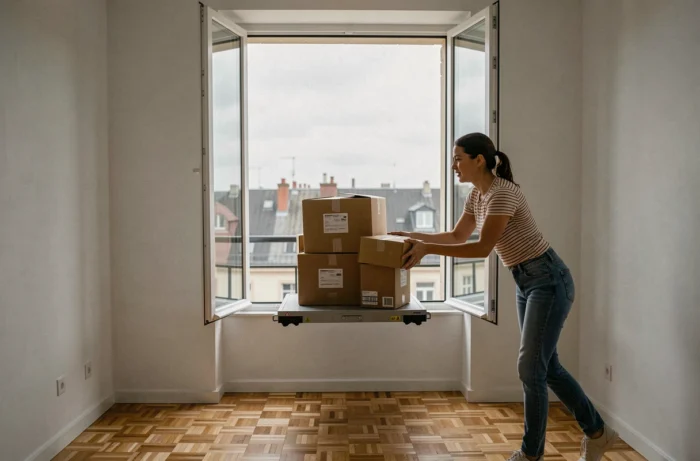
The specific case of one-off deliveries
The rental of a lift is not only for complete moves. A purchase of bulky furniture, the installation of an indoor spa, or the delivery of heavy professional equipment also justifies the use of a facade elevator. In these cases, a rental for a few hours is usually sufficient, which limits the expense.
Preparing for the big day: checklist before the lift arrives
The lift is reserved, the parking permit obtained. Now, prepare the site so that the operation runs smoothly without wasting time.
- Clear access from the street side: no vehicles parked in front of the installation area. If necessary, place parking reservation signs (provided by the town hall with the permit).
- Open the windows through which the furniture will pass and remove any obstacles (blinds, planters, thick curtains). Measure the usable opening of the window and compare it to the dimensions of your largest pieces of furniture.
- Protect the window frames with blankets or thick cardboard. The repeated passage of heavy loads quickly damages the woodwork.
- Plan a logical order of passage: the heaviest and bulkiest items first, then the boxes. This avoids repositioning the platform unnecessarily.
A well-prepared move with a lift takes significantly less time than a traditional move using the stairs. The time saved more than compensates for the rental cost, especially from the third floor without an elevator.
Ultimately, the question is not whether a lift is expensive, but how much a broken piece of furniture, a strained back, or a move extended by several hours would cost. On that calculation, the answer almost always tips to the same side.