
Essential oils are concentrated sources of aromatic molecules whose pharmacological power is often underestimated. Their impact on the liver varies significantly depending on the dominant molecule, the route of administration, and the duration of exposure. Understanding which chemical families affect hepatocytes allows for adjustments in usage and helps avoid sometimes severe liver damage.
Phenols, ketones, and terpenes: a comparative hepatotoxic profile
Not all essential oils threaten the liver in the same way. The risk depends on the predominant chemical family in each oil. Three categories concentrate the majority of signals of hepatic toxicity.
| Chemical family | Common molecules | Essential oils concerned | Hepatic mechanism |
|---|---|---|---|
| Phenols | Carvacrol, eugenol, thymol | Oregano, savory, clove, thyme with thymol | Interference with hepatic enzymes, alteration of hepatocytes at high doses |
| Ketones | Thujone, camphor, menthone | Common sage, rosemary with camphor, peppermint | Metabolic overload of the liver, increased risk with prolonged oral use |
| Monoterpenes (high dosage) | Limonene, pinene | Eucalyptus, Scots pine | Moderate toxicity, especially in cases of pre-existing liver fragility |
Phenols represent the most documented group regarding hepatotoxicity. Carvacrol, found in oregano and savory, as well as eugenol from cloves, directly disrupt the enzymatic function of the liver when absorbed in high doses or over long periods.
Ketones pose a different problem. They engage the liver’s detoxification pathways and can saturate the liver’s processing capacity. Peppermint, often presented as having neurological rather than hepatic risk at usual doses, illustrates the need to distinguish toxicity profiles oil by oil.
Better understanding the dangers of essential oils for the liver requires moving beyond the generic category “essential oil” to reason in terms of molecules and concentrations.
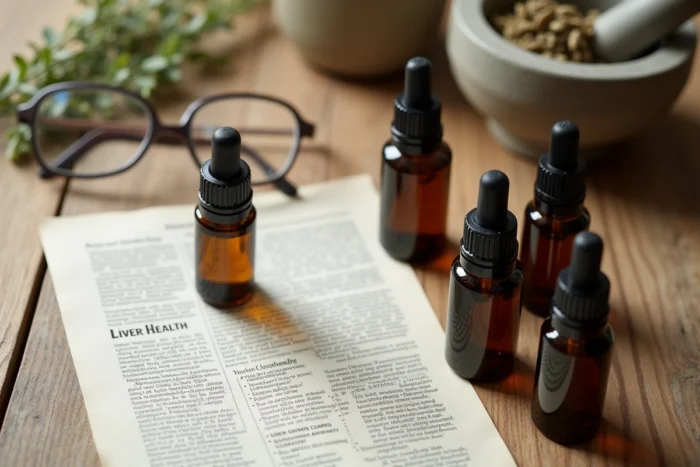
Oral, cutaneous, and diffusion routes: the liver is not exposed in the same way
The route of administration radically alters the level of hepatic risk. The oral route is the most directly toxic to the liver, as the molecules pass through the digestive system and then the liver (first-pass hepatic effect) before entering the general circulation.
The cutaneous route does not exempt from vigilance. Application over large skin areas, under occlusive dressings or with a heat source increases systemic absorption. The molecules then enter the bloodstream in sufficient quantities to affect the liver, a point that most usage guides mention without really detailing.
Atmospheric diffusion presents the lowest hepatic risk, but it is not without effect. The volatile organic compounds released can cause respiratory irritations, and prolonged exposure in a poorly ventilated space remains a burden for the body. The ANSES has also published toxicovigilance data reporting cases of poisoning related to sprays and diffusers containing essential oils.
Factors that exacerbate hepatic exposure
- Prolonged duration of use: daily use over several weeks multiplies the metabolic burden on the liver, even at moderate doses
- Cutaneous application under occlusion or with heat: transcutaneous absorption increases and approaches levels reached by the oral route
- Pre-existing liver fragility: cirrhosis, hepatitis, steatosis, or regular alcohol consumption reduce the liver’s ability to metabolize aromatic molecules
- Polypharmacy: some essential oils share the same hepatic metabolic pathways as common medications, which can alter the effectiveness of a treatment or increase its toxicity
Drug interactions and hepatotoxic essential oils
Interactions between essential oils and medications at the liver level constitute a rarely explored angle. The liver uses a set of enzymes (notably cytochrome P450) to metabolize both medications and aromatic molecules.
When an essential oil rich in phenols or ketones mobilizes these same enzymes, it competes with the medication treatment. The medication may then be metabolized more slowly or more quickly than expected, with consequences for its effectiveness or toxicity.
Individuals on anticoagulants, undergoing treatment for epilepsy, or on immunosuppressants are particularly affected. Eugenol from cloves, for example, interferes with blood coagulation. Thymol from thyme with thymol, at high oral doses, can disrupt the metabolism of certain hepatic medications.
Concrete precautions in case of long-term treatment
Anyone on chronic treatment should inform their doctor or pharmacist about the use of essential oils orally. This precaution also applies to the cutaneous route when it involves repeated applications over large areas.
Phenol-rich oils should never be used orally without medical advice in a polymedicated person. Self-medication with essential oils, often perceived as harmless, can compromise a therapeutic protocol.

Essential oils of thyme, savory, and oregano: hepatic tolerance thresholds
Thyme with thymol, mountain savory, and compact oregano form a trio frequently cited in aromatherapy for their anti-infectious properties. These three oils share a profile rich in phenols, making them effective against infections but also among the most aggressive for liver cells.
Their oral use is generally limited to a few days in structured protocols. Beyond that, the risk of liver damage increases significantly. Individuals suffering from hepatic steatosis, hepatitis, or cirrhosis should avoid them entirely, regardless of the route of administration.
Dilution in a vegetable oil reduces the cutaneous risk but does not alter systemic toxicity once the molecules are absorbed. The concentration of phenols remains the same after dilution, only the amount applied per unit area decreases.
The use of these potent essential oils should be occasional, targeted, and ideally supervised by a professional trained in clinical aromatherapy. The liver, a central organ of detoxification, does not always immediately signal an overload, making liver damage all the more insidious.