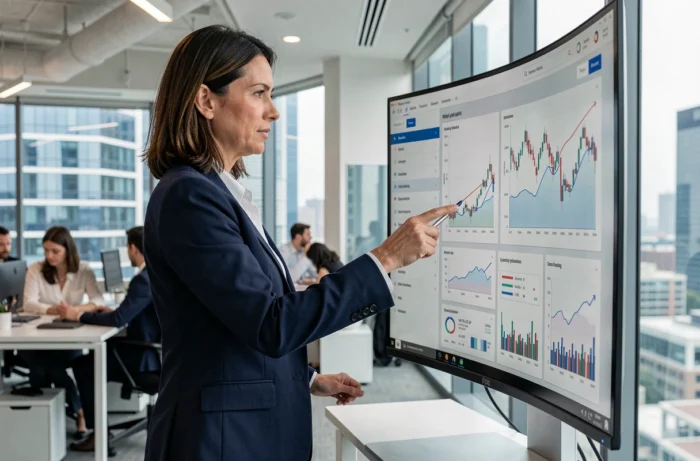
Electronic invoicing is about more than changing formats. Structured invoices, combined with lifecycle tracking, give businesses a faster view of late payments, cash flow, and certain indicators by customer or business activity. This process, together with growing demand for sustainability data across value chains, is reshaping what it means to run a business in 2026.
Electronic invoicing in 2026: from form to management dashboard
Most articles on business trends treat electronic invoicing as a regulatory box to tick. But there’s more to it. A structured invoice contains standardized fields (amount, due date, processing status) that, once aggregated, generate management indicators without manual data entry.
In practical terms, a small business that issues invoices through an approved electronic invoicing platform can see in real time which customers are paying late, which business activity generates the most outstanding receivables, and its short-term cash position. Before this reform, this data existed, but was scattered across spreadsheets, email reminders, and bank statements.
However, the business value hinges on one specific factor: integration between invoicing, accounting, and management tools. Without this connection, data remains siloed and the management benefits disappear. For more on these transformation strategies, Emploi Biz’s business analysis regularly explores the models that work in this context.
Rejections, duplicates, and data quality
Early deployment feedback has revealed practical operational challenges. Businesses report, in particular, rejected and duplicate invoices, as well as IT migration issues and difficulties understanding processing statuses.
These issues are not minor. They show that process and data quality are transformation challenges in their own right, beyond simply choosing software. A business that fails to clean up its customer and product records before migration ends up with misleading indicators, undermining the expected management benefits.

ESG data and the value chain: what small businesses need to anticipate
The scope of European CSRD reporting has recently been narrowed. Some businesses preparing for full reporting are no longer directly subject to the requirement. The distinction is this: direct regulatory obligations are easing, but commercial expectations remain.
A company subject to the CSRD continues to ask its suppliers, including the smallest ones, for data on their carbon emissions, energy consumption, or social practices. The pressure comes not from the regulator, but from the customer.
For a small business, the question becomes practical: how can it collect this data without rolling out a disproportionate reporting system? Three approaches stand out:
- Use data already available in electronic invoicing (purchase volumes by supplier, spending categories) to estimate a footprint without a major audit
- Use standardized questionnaires offered by industry platforms rather than responding to each customer separately
- Document existing practices (waste sorting, choosing local suppliers, travel policies) in a structured format that can be reused for different requests
The goal is not to produce an 80-page ESG report. It is to turn a reporting requirement into useful information for making your own decisions: identify the most exposed spending categories, flag at-risk suppliers, and weigh up different sourcing options.
Management tools for small businesses in 2026: choose the right fit
The electronic invoicing timeline sets a separate deadline for small businesses, driving demand for support, software integration, and training. The market for tools is booming as a result, and the main risk for a small business is choosing a solution that is too complex.
Management software suited to a five-person business is not the same as an ERP designed for a mid-sized company. The practical selection criteria are different:
- Is the platform approved for electronic invoicing, or is an additional connector required?
- Can the tool generate cash flow and payment-term indicators without complex configuration?
- Can the data be used to complete a simple ESG questionnaire if a customer asks for one?
- Is the monthly cost proportionate to the business’s revenue?
The appeal of an “all-in-one” solution is strong, but a small business that pays for unused modules wastes money and complicates its processes. A limited but well-managed tool is better than a full suite that is underused.
Training and support: the real investment
Software costs are often just the visible part. The investment that really makes a difference is staff training. An accountant used to PDF invoices won’t switch overnight to a structured workflow with status tracking.
Businesses that benefit from this transition are those that invest a few days in targeted training rather than spending months adapting through trial and error. Feedback from the field confirms that difficulties understanding processing statuses are among the most common sources of friction after deployment.

Business trends in 2026: combining data flows to manage differently
What electronic invoicing and ESG requests have in common is the generation of usable structured data. Taken separately, these requirements look like administrative burdens. Combined, they create a dashboard that many small businesses did not have before.
Payment terms by customer, viewed alongside purchase volumes and sustainability data, make it possible to segment a customer portfolio differently. A customer who pays late and refuses to provide ESG data poses a greater risk than one who pays on time and is transparent. This kind of analysis, which was still limited to large companies two years ago, is becoming accessible thanks to standardized data flows.
The underlying trend for 2026 is not a miracle sector or a single technology. It is the ability to turn regulatory requirements into decision-making tools, without an outsized budget, by using data the business already produces.