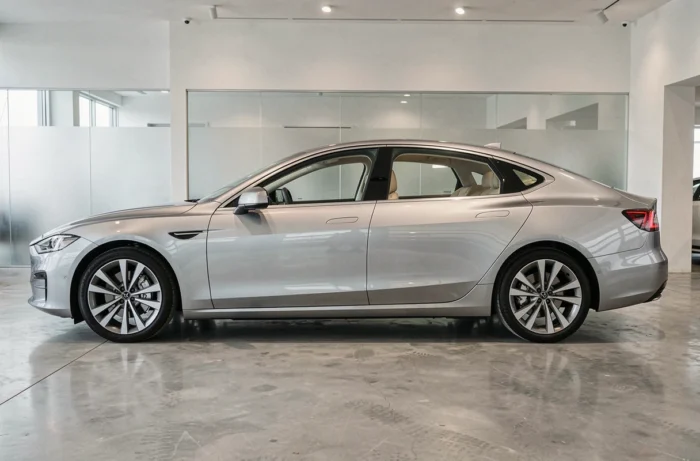
On November 4, 2026, the European Parliament’s Environment Committee voted on a text that would significantly reshape the automotive industry’s CO₂ targets. The vote is not yet legally binding: it must go before the full Parliament and then be negotiated with the member states. The current rules therefore remain in force. The stakes go beyond the question of combustion engines after 2035, as the proposed credit mechanisms would shift the balance between manufacturers depending on where they produce their vehicles and how their supply chains are structured.
CO₂ credits for small European electric cars: who would benefit
The parliamentary compromise introduces a weighting system for calculating each manufacturer’s average emissions. A small electric car under 4.2 metres long, made in the EU, would count as 1.4 vehicles instead of one. A highly efficient European electric model would count as 1.2.
This mechanism would not benefit all manufacturers equally. A group that assembles its electric city cars in Europe on production lines supplied with low-carbon steel would receive a double bonus: the credit linked to vehicle size and the one linked to supply-chain efficiency. A competitor importing its models from outside the EU would not qualify, even if the vehicle were technically identical.
To follow L’Actu Auto news on these regulatory developments, the issue is worth monitoring closely, as negotiations remain open.
2030 and 2035 CO₂ targets: current rules compared with the parliamentary proposal
The text voted on by the committee covers more than just passenger cars. It also applies to light commercial vehicles, with significant differences from the targets currently in force.
| Category | Deadline | Current target | Parliamentary committee proposal |
|---|---|---|---|
| Light commercial vehicles | 2030 | -50% CO₂ | -35% |
| Light commercial vehicles | 2035 | -100% CO₂ | -80% |
| Passenger cars (small EU EV, under 4.2 m) | From adoption | Counted as 1 vehicle | Counted as 1.4 vehicles |
| Passenger cars (highly efficient EU EV) | From adoption | Counted as 1 vehicle | Counted as 1.2 vehicles |
The difference for light commercial vehicles is the most striking. Moving from -50% to -35% in 2030 would give van and minivan manufacturers considerably more leeway. Renault, Volkswagen and Ford, which make a large share of their light commercial vehicles in Europe, could redirect their R&D investment towards hybridisation rather than fully electric vehicles in this segment.
For 2035, keeping the target at -80% instead of -100% would mean that manufacturers could still sell a residual share of combustion-engine or plug-in hybrid light commercial vehicles. This flexibility would mainly benefit brands whose professional charging networks remain limited in rural areas.
Supply chains and low-carbon steel: the overlooked factor
Public debate focuses on the type of engine. The proposed credits shift some of the competitive advantage towards the production chain itself. A manufacturer sourcing low-carbon steel from European steelmakers committed to decarbonisation—for example, using electric furnaces powered by renewable energy—could position its vehicles more favourably in the overall efficiency calculation.
Where a vehicle is assembled becomes a regulatory compliance criterion, not just an industrial choice. The recent alliance between Ford and Geely to manufacture in Spain illustrates this logic: producing in Europe provides access to credits, even for a Chinese group.
- A model assembled in the EU using European low-carbon steel would qualify for both the location bonus and the efficiency bonus.
- An imported vehicle, however efficient, would qualify for neither of these credits under the current proposal.
- Manufacturers that have already relocated or consolidated their European production (Dacia in Romania, BYD, which is exploring sites in Hungary) are positioned differently depending on whether final assembly takes place in the EU.
The place of manufacture carries as much weight as powertrain technology in the proposed credit system. This shift structurally favours groups that have kept or brought production lines back to Europe.
BYD, Volkswagen, Renault: three profiles, three impacts
BYD is preparing a small electric city car for the European market. If it is under 4.2 metres long and BYD assembles it in the EU, it would count as 1.4 vehicles in the emissions calculation. If assembled in China and then exported, it would count as one.
Volkswagen, in the midst of a restructuring involving large-scale voluntary departures, retains a dense network of European factories. If its future electric city cars are made in the EU, they would qualify for the credit without any additional logistics investment.
With the Dacia Spring and future models based on the AmpR Small platform, Renault will have to weigh production costs (some models are assembled outside the EU) against eligibility for credits. The trade-off between labour costs and regulatory bonuses is becoming a strategic consideration in its own right.
Euro 7 standard: regulation extends beyond the exhaust
Alongside the debate over 2035, the Euro 7 standard broadens the scope of what is measured and monitored in a new vehicle. Brake particles and tyre abrasion are being brought within the regulatory framework for the first time. Battery durability requirements are also planned.
The implementation schedule is gradual. The standard does not yet apply to all new cars, but its phased introduction is already changing equipment manufacturers’ specifications. Brake pad and tyre suppliers must adapt their formulations to reduce non-exhaust particle emissions.
For manufacturers, this means an additional cost per vehicle, varying by model range. Heavy SUVs, whose braking systems generate more particles, are more exposed than lightweight city cars. This factor indirectly strengthens the case for small electric vehicles in the product mix.
The text on post-2035 CO₂ targets remains a parliamentary committee proposal, not a law. Negotiations with the member states could change the weighting coefficients, size thresholds or eligibility conditions. No manufacturer can yet base its industrial strategy on these figures as if they were final.
The only certainty is that European production and supply-chain decarbonisation now carry as much weight in discussions as the choice of engine.